
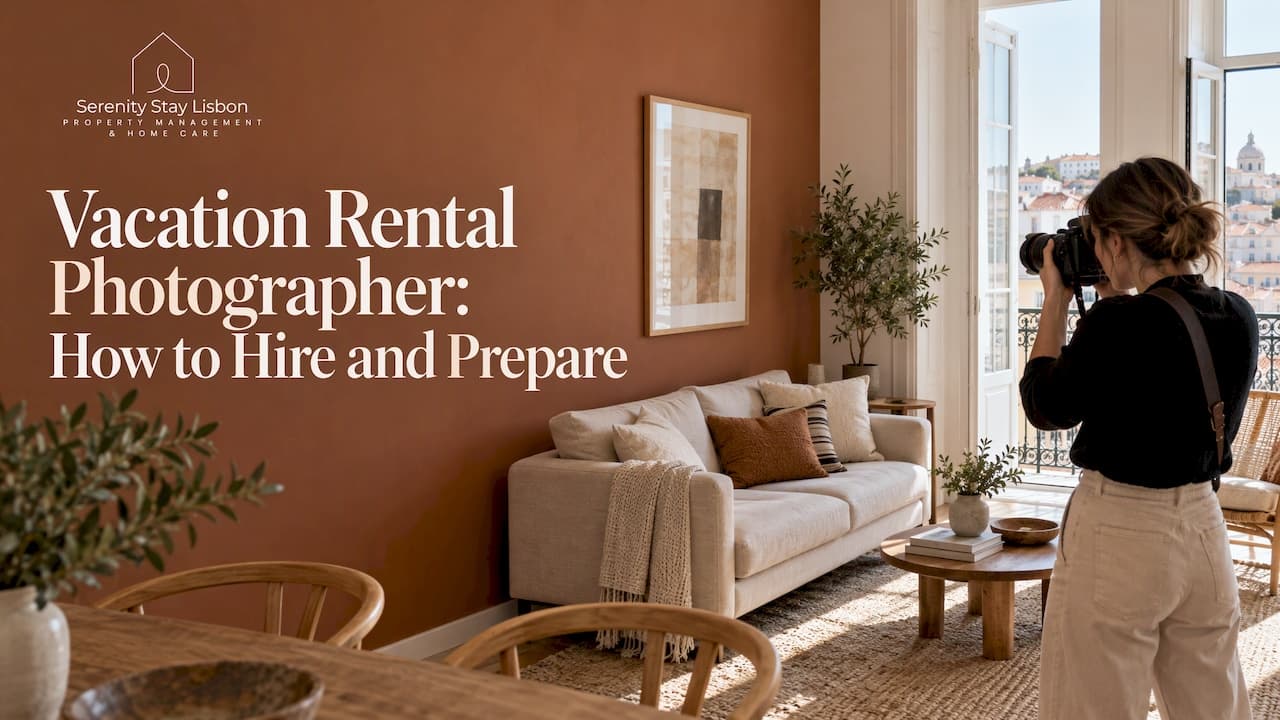
A vacation rental photographer shoots your property so that guests can judge it at a glance: bright, accurate, complete images of every space they will use. Hire one who works with short-term rentals, prepare the home properly the day before, and ask for a full shot list rather than a handful of pretty frames. Photos are the first thing a guest sees, so this is one of the highest-return jobs you can do on a listing.
This guide covers what a rental photographer actually delivers, how to prepare and stage the property, which shots and how many you need, the mistakes that quietly cost bookings, and the inventory and furniture checklists that make a shoot go smoothly.
TL;DR
- Airbnb states that professional photos are one of the biggest factors guests weigh when choosing a listing, so treat the shoot as part of your pricing strategy, not an extra.
- Prepare the property before the photographer arrives: lights off, blinds open, surfaces cleared, beds made tight, outdoor furniture arranged.
- Plan for 25 to 35 photos in most cases, led by a strong cover image, the main bedroom, the kitchen and your best outdoor space.
- Avoid harsh overhead lighting, visible personal items, smudged glass and wide-angle tricks that make rooms look bigger than they are.
- Keep a room-by-room inventory and furniture checklist so the home is complete, consistent and easy to photograph again after any update.
Table of Contents
- What a vacation rental photographer does
- How to choose a photographer
- How to prepare and stage before the shoot
- The shot list: which photos, and how many
- Vacation rental photography mistakes to avoid
- Inventory and furniture checklists before the shoot
- Let us handle the shoot and everything after
- FAQ
- Sources
What a vacation rental photographer does
A general real estate photographer sells a house to a buyer. A vacation rental photographer sells a stay to a guest. The difference matters: a buyer wants to see structure and square footage, while a guest wants to picture waking up, cooking breakfast and sitting on the terrace at sunset.
In practice, the job covers four things:
- Coverage. Every guest-accessible room and area, plus the details that justify your nightly rate, such as a espresso machine, a view, a hot tub or a desk by a window.
- Light and composition. Natural light where possible, straight verticals, consistent color, and horizontal framing that survives the crop into square thumbnails in search results.
- Editing. Brightness, contrast and highlight correction, plus cropping and straightening, with a realistic result.
- Delivery. A gallery in a sensible order, in high resolution, ready to upload.
Airbnb's own program gives a useful benchmark. According to its help article on professional photography, a freelance photographer takes two to three images per room, a team of editors enhances them, and the new images go live on the listing within about one week of the shoot. A dedicated vacation rental photographer working independently will usually give you more coverage than that, but the structure is the same.
Does it pay off?
Airbnb says that listings with its pro photography see more bookings on average. The same page explains that the cost of the shoot is subtracted from future payouts and only posted after the new images are live, and that 85% of hosts pay for their shoot within one reservation. Those are Airbnb's own program figures, so they describe that program specifically, but they show how quickly a good gallery can cover its cost on a decently priced listing.
There is also a revenue case study from a co-hosting company. Home Co-Host documented a property that hired a professional vacation rental photographer and saw roughly $12,000 in additional annual revenue over twelve months, driven by higher occupancy and a higher average daily rate. That is one property, not a promise, but the mechanism is easy to understand. Strong photos build trust, make the home look clean and well managed, and give you room to charge more than neighbors whose images look casual.
How to choose a photographer
You do not need a long list of criteria. You need a photographer whose portfolio looks like the stays you want to attract. Check these points before booking:
- Rental-specific portfolio. Look for full property galleries, not just single hero images. You want to see how they handle bedrooms, bathrooms and small kitchens, which are the hardest rooms.
- Natural, accurate color. Walls, wood and fabrics should look the way they look in person. Heavy filters create disappointment at check-in, and disappointment becomes reviews.
- Clear scope. Ask how many final images are included, whether twilight or exterior shots are part of the package, how long editing takes, and whether you receive full-resolution files for every platform.
- Usage rights. Confirm in writing that you can use the images on your own booking site, on every listing platform and in ads.
- Shoot logistics. Ask how long the shoot takes, who needs to be on site and what they expect you to prepare.
- Reshoot terms. Airbnb states that its pro photo shoots are offered once per listing and are not refundable once they begin, so if you go the platform route, make sure the property is truly ready first. Independent photographers set their own terms, so agree them upfront.
Timing matters too. Shoot when the property is finished: furniture delivered, art hung, plants alive, linens ironed. Booking a photographer before the final furniture arrives is the most common reason owners end up paying for two shoots.
How to prepare and stage before the shoot
Staging is where most of the visual quality is decided. Airbnb publishes a photoshoot preparation guide that works for any photographer. The essentials:
Everywhere
- Turn off lamps and overhead lights, and open blinds, shades and curtains so natural light does the work.
- Remove clutter from surfaces, and hide cables.
Bedrooms
- Smooth the comforter and fluff the pillows.
- Clear bedside tables, dressers and desks.
Bathrooms
- Arrange toiletries and towels neatly.
- Clean mirrors, glass doors and handles until they show no fingerprints.
Living areas and kitchen
- Fluff pillows and smooth throws and cushions.
- Declutter tables and shelves, and space dining chairs evenly.
- Clean countertops and put away cooking ingredients.
Outdoors
- Arrange patio or balcony furniture, sweep, and remove anything that does not belong in the frame.
Timing and furniture placement
Houfy's staging guide suggests finishing staging 60 to 90 minutes before the photographer arrives, and pulling furniture 8 to 12 inches from walls to create depth that makes rooms feel larger. It also makes a point owners often resist: removing items makes a room look larger, not emptier. A coffee table with a single vase reads as intentional. The goal is a space that feels clean, welcoming and ready for the guest, not someone else's home.
A practical routine that works well for owners who live abroad:
- Deep clean two days before, including windows.
- The day before, replace worn linens and towels with a crisp matching set.
- On the morning, do a final walk-through with a short checklist, then step out of the way.
- Keep a small box nearby for last-minute clutter that appears while the photographer is working.
The shot list: which photos, and how many
Cover every space a guest can use, and add the details that explain your price. A reliable shot list:
| Shot | Why it matters |
|---|---|
| Hero image (exterior or best interior) | Becomes the cover photo and decides the click |
| Living area | Shows comfort and layout |
| Kitchen | Guests check it closely for cooking equipment |
| Each bedroom | Show the bed, storage and natural light |
| Each bathroom | Cleanliness and fixtures |
| Outdoor space | Often the deciding feature |
| Key amenities | Pool, hot tub, fireplace, view, parking |
| Workspace | Important for longer stays |
| Neighborhood context | Answers the question of where guests are |
The same list appears in Weekender Management's listing guide, which recommends 25 to 40 photos.
How many photos is enough?
Sources vary slightly, but they cluster. 10XBNB's guide says Airbnb allows up to 100 photos per listing, that 25 to 35 detailed photos suit most properties, that fewer than 15 makes guests assume something is hidden, and that the first five photos get roughly 80% of views. Houfy's booking page guide recommends 20 to 35 and warns that going past 40 without variety loses attention. These are practitioner guidelines, not platform rules, so use them as a range: 25 to 35 for a typical home, more only if each image shows something new.

Order of the first five
Lead with the cover photo, then the largest bedroom, the kitchen, the outdoor space and one wow-factor image: the view, the pool, the terrace. After that, move through the home the way a guest would walk it.
File specs
Airbnb's photo guidance asks for high resolution, at least 1200 by 800 pixels, with larger files better up to about 10 megabytes, and horizontal framing because images are cropped to squares in search results. Ask your photographer to deliver at full size and let the platform compress.
Vacation rental photography mistakes to avoid
Most bad galleries fail for ordinary reasons, and most are fixable before the shoot.
Harsh overhead lighting. 10XBNB's Shaun Ghavami explains that overhead lights create hard downward shadows and yellow or blue color casts that flatten a room. Airbnb's guidance agrees in spirit: use soft natural light, open the curtains, avoid flash, and turn on interior lights only when daylight is not enough. For exteriors, shoot in the golden hours after sunrise or before sunset.

Clutter and personal items. HostAI's photography guide lists visible owner belongings and excessive decoration as trust-damaging. Clutter also suggests carelessness, and guests assume that carries into the stay.
Dirty glass and mirrors. Lenses see fingerprints that eyes miss. Wipe mirrors, shower glass, windows and appliance fronts right before shooting.
Incomplete galleries. Skipping the bathroom or the second bedroom invites questions and suspicion. Show every guest-accessible space.
Distorted or inaccurate images. Ultra-wide lenses can make a small room look huge, and heavy editing can shift wall colors or blow out windows. The same HostAI guide flags images that make a room appear larger than it is. Airbnb recommends editing brightness, contrast and highlights and straightening or cropping, while keeping results realistic. A guest who arrives to a smaller room than the photo implied will write about it.
Shooting before the home is finished. Missing curtains, bare walls and temporary furniture all end up in the gallery for years. Complete the setup first.
Inventory and furniture checklists before the shoot
A photographer shows what is in the home, so it helps to know exactly what that is. Two checklists save time: an inventory for what exists, and a furniture and supplies list for what a guest expects.
Vacation rental inventory checklist
Go room by room and record each item, its count and its condition. A solid inventory covers:
- Furniture and fixtures
- Appliances, with make and model where useful
- Kitchenware and dishes, counted
- Linens and towels, by set
- Keys, remotes and access items
- Safety essentials such as smoke alarms and first aid
- Utility details like meter locations and shut-offs
- Dated photos of each room's condition
The dated photos serve double duty: they document condition for damage claims and give you a baseline for what "ready to shoot" looks like. When a lamp breaks or a set of dishes disappears, you know what to replace before the next shoot.
Airbnb furniture checklist
Airbnb's guide to preparing your space is a good baseline. For furniture and fittings, plan for:
- Seating, tables and dining furniture
- Beds and nightstands
- Storage for guests' belongings
- Window coverings and lamps
- Table settings, a coffee maker and a kettle
- Pots, pans and cooking utensils
- A TV
- Linens, towels and bathroom basics
- A few useful extras that fit your guests
Use the same list as a furnishing checklist when you are setting up a new property. Anything missing at shoot time either appears as a gap in the photos or gets added later, which means another shoot.
Our perspective on photography and ownership
We manage short-term rentals in Lisbon, and we see photography as the first operational decision, not a marketing afterthought. A gallery makes a promise to every guest, and the rest of the stay, from the cleaning to the welcome to the way we answer messages, has to keep that promise. That is why we prepare and present each property the way we would our own.
We are a family-run business, so owners talk to us directly. Photos, pricing and guest communication are connected: strong images support the nightly rate, our dynamic pricing works on that rate, and consistent guest communication protects the reviews that follow. The same applies to inventory and furnishing. A complete, well-kept home is easier to photograph, easier to clean between stays and easier to inspect.
For owners who do not live nearby, we handle the details: coordinating cleaning, preparing the property before the shoot and keeping an eye on it through regular security inspections. Our aim is that you get a listing you are proud of and a property that stays safe.
the author
Let us handle the shoot and everything after
If you own an apartment or villa in Lisbon, photography is only one piece of getting a listing to perform. We take care of the whole process: listing creation, professional photography, dynamic pricing, guest communication, cleaning coordination and maintenance, all under our full Airbnb management service. Our fee is a 20% commission on rental income.

If the property is a second home that sits empty part of the year, our residence guardianship covers regular security inspections, mail handling and preparing the home for your own stays. You can see both on our services page, and the owner's checklist is a good first step before you commit to a shoot. To understand how photos feed into pricing and occupancy, read our practical guide to vacation rental revenue management.
FAQ
How many photos should a vacation rental listing have?
For most properties, 25 to 35 photos is a good target, and several practitioner guides put the range between 20 and 40. Fewer than 15 can make guests assume something is hidden. Add more only if each new image shows something different.
What should I do before the photographer arrives?
Turn off lamps and overhead lights, open all blinds and curtains, and clear surfaces. Make beds neatly, arrange towels and toiletries, clean mirrors and glass, and set up outdoor furniture. Finish staging about 60 to 90 minutes before the arrival time.
Should I shoot with natural or artificial light?
Natural light is the first choice. Airbnb recommends soft daylight, no flash and interior lights only when daylight is not enough. Outdoors, the golden hours after sunrise and before sunset flatter most properties.
Can I use the same photos on every booking platform?
Yes, provided your agreement with the photographer allows it. Confirm usage rights in writing and ask for full-resolution, horizontally framed files. Airbnb's guidance asks for at least 1200 by 800 pixels, and the platform crops images to squares in search results.
Sources
- Airbnb Pro Photography Program
- Airbnb help article on professional photography
- Airbnb help article on photo shoot terms
- Airbnb: Getting ready for your photoshoot
- Airbnb Resource Center: How to take great photos for your listing
- Airbnb Resource Center: Prepare your space
- Home Co-Host: Professional photos vs iPhone snaps
- Houfy: Vacation Rental Staging Guide
- Houfy: Vacation Rental Booking Page Elements
- 10XBNB: Airbnb Photography Guide
- Weekender Management: Listing Optimization Guide
- HostAI: Vacation Rental Photography